Friday, December 10, 2010
Fun Audio Listen
Normally, I don't post audio books here but in the Books "Read" 2010. And yes, I have sadly neglected that blog and so be patient. Still, Joe and I listened to another awesome audio book yesterday and so I am putting in a plug here for it. (Very reasonably priced on Amazon. Ours was reserved and checked out from the local library :) Every since the PTSS (Post traumatic Stress Syndrome) diagnosis from reading and then listening to Mockingjay--I've done a 180 and started listening to Anne of Green Gables (funny, innocent, smart, imaginative, classic...), The Secret Garden, Anne of Avolea, and These is My Words (all good on audio book, by the way). Our latest listening pleasure has been Rick Riordan's The 39 Clues Book 1: A Maze of Bones. Excellent reader (Jim Dale watch out)! Very entertaining, funny, mysterious, thrilling, oh--and very PG. (No girl lying on the pavement in someone else's warm blood scenes.)

Thursday, December 9, 2010
BYU Divine Comedy
There is a funny spoof about Co-eds at BYU. See the video here.
and YES--I am a PROVO, UTAH Girl! Ahem--I mean "gurl."
A Secret For Woman: When Queens Ride By
When Queens Ride By
This is a long "short" story but has reminded me of the power and gifts that woman have been endowed with. Mom Clayton brought this story to my attention. It was once published in a newspaper column and I believe it still has the power that it had then.
When Queens Ride By by Agnes Slight Turnbull, 1888
Jennie Musgrave woke at the shrill rasp of the alarm clock as she always woke—with the shuddering start and a heavy realization that the brief respite of the night's oblivion was over. She had only time to glance through the dull light at the cluttered, dusty room, before John's voice was saying sleepily as he said every morning, "All right, let's go. It doesn't seem as if we'd been in bed at all!"
Jennie dressed quickly in the clothes, none too clean, that, exhausted, she had flung from her the night before. She hurried down the back stairs, her coarse shoes clattering thickly upon the bare boards. She kindled the fire in the range and then made a hasty pretense at washing in the basin in the sink.
John strode through the kitchen and on out to the barn. There were six cows to be milked and the great cans of milk to be taken to the station for the morning train.
Jennie put coffee and bacon on the stove, and then, catching up a pail from the porch, went after John. A golden red disk broke the misty blue of the morning above the cow pasture. A sweet, fragrant breath blew from the orchard. But Jennie neither saw nor felt the beauty about her.
She glanced at the sun and thought, It's going to be a hot day. She glanced at the orchard, and her brows knit. There it hung. All that fruit. Bushels of it going to waste. Maybe she could get time that day to make some more apple butter. But the tomatoes wouldn't wait. She must pick them and get them to town today, or that would be a dead loss. After all her work, well, it would only be in a piece with everything else if it did happen so. She and John had bad luck, and they might as well make up their minds to it.
She finished her part of the milking and hurried back again to the overcooked bacon and strong coffee. The children were down, clamorous, dirty, always underfoot. Jim, the eldest, was in his first term of school. She glanced at his spotted waist. He should have a clean one. But she couldn't help it. She couldn't get the washing done last week, and when she was to get a day for it this week she didn't know, with all the picking and the trips to town to make!
Breakfast was hurried and unpalatable, a sort of grudging concession to the demands of the body. Then John left in the milk wagon for the station, and Jennie packed little Jim's lunch basket with bread and apple butter and pie, left the two little children to their own devices in the backyard, and started toward the barn. There was no time to do anything in the house. The chickens and turkeys had to be attended to, and then she must get to the tomato patch before the sun got too hot. Behind her was the orchard with its rows and rows of laden apple tree. Maybe this afternoon—maybe tomorrow morning. There were the potatoes, too, to be lifted. Too hard work for a woman. But what were you going to do? Starve? John worked till dark in the fields.
She pushed her hair back with a quick, boyish sweep of her arm and went on scattering the grain to the fowls. She remembered their eager plans when they were married, when they took over the old farm—laden with its heavy mortgage—that had been John's father's. John had been so straight of back then and so jolly. Only seven years, yet now he was stooped a little, and his brows were always drawn, as though to hide a look of ashamed failure. They had planned to have a model farm someday: blooded stock, a tractor, a new barn. And then such a home they were to make of the old stone house! Jennie's hopes had flared higher even than John's. A rug for the parlor, an overstuffed set like the one in the mail—order catalogue, linoleum for the kitchen, electric lights!
They were young and, oh, so strong! There was nothing they could not do if they only worked hard enough.
But that great faith had dwindled as the first year passed. John worked later and later in the evenings. Jennie took more and more of the heavy tasks upon her own shoulders. She often thought with some pride that no woman in the countryside ever helped her husband as she did. Even with the haying and riding the reaper. Hard, coarsening work, but she was glad to do it for John's sake.
The sad riddle of it all was that at the end of each year they were no further on. The only difference from the year before was another window shutter hanging from one hinge and another crippled wagon in the barnyard which John never had time to mend. They puzzled over it in a vague distress. And meanwhile life degenerated into a straining, hopeless struggle. Sometimes lately John had seemed a little listless, as though nothing mattered. A little bitter when he spoke of Henry Davis.
Henry held the mortgage and had expected a payment on the principle this year. He had come once and looked about with something very like a sneer on his face. If he should decide someday to foreclose—that would be the final blow. They never would get up after that. If John couldn't hold the old farm, he could never try to buy a new one. It would mean being renters all their lives. Poor renters at that!
She went to the tomato field. It had been her own idea to do some tracking along with the regular farm crops. But, like everything else, it had failed of her expectations. As she put the scarlet tomatoes, just a little overripe, into the basket, she glanced with a hard tightening of her lips toward a break in the trees a half mile away where a dark, listening bit of road caught the sun. Across its polished surface twinkled an endless procession of shining, swift—moving objects. The State Highway.
Jennie hated it. In the first place, it was so tauntingly near and yet so hopelessly far from them. If it only ran by their door, as it did past henry Davis's for instance, it would solve the whole problem of marketing the fruits and vegetables. Then they could set the baskets on the lawn, and people could stop for them. But as it was, nobody all summer long had paid the least attention to the sign John had put up at the end of the lane. And no wonder. Why should travelers drive their cars over the stony country byway, when a little farther along they would find the same fruit spread temptingly for them at the very roadside?
But there was another reason she hated that bit of sleek road showing between the trees. She hated it because it hurt her with its suggestions of all that passed her by in that endless procession twinkling in the sunshine. There they kept going, day after day, those happy, carefree women, riding in handsome limousines or in gay little roadsters. Some in plainer cars, too, but even those were, like the others, women who could have rest, pleasure, comfort for the asking. They were whirled along hour by hour to new pleasures, while she was weighted to the drudgery of the farm like one of the great rocks in the pasture field.
And—most bitter thought of all—they had pretty homes to go back to when the happy journey was over. That seemed to be the strange and cruel law about homes. The finer they were, the easier it was to leave them. Now with her—if she had the rug for the parlor and the stuffed furniture and linoleum for the kitchen, she shouldn't mind anything so much then; she had nothing, nothing but hard slaving and bad luck. And the highway taunted her with it. Flung its impossible pleasures mockingly in her face as she bent over the vines or dragged the heavy baskets along the rows.
The sun grew hotter. Jennie put more strength into her task. She knew, at last, by the scorching heat overhead that is was nearing noon. She must have a bit of lunch ready for John when he came in. There wasn't time to prepare much. Just reheat the coffee and set down some bread and pie.
She started towards the house, giving a long yodeling call for the children as she went. They appeared from the orchard, tumbled and torn from experiments with the wire fence. Her heart smothered her at the sight of them. Among the other dreams that the years had crushed out were those of little rosy boys and girls in clean suits and fresh ruffled dresses. As it was, the children had just grown like farm weeds.
This was the part of all the drudgery that hurt most. That she had not time to care for her children, sew for them, teach them things that other children knew. Sometimes it seemed as if she had no real love for them at all. She was too terribly tired as a rule to have any feeling. The only times she used energy to talk to them was when she had to reprove them for some dangerous misdeed. That was all wrong. It seemed wicked; but how could she help it? With the work draining the very life out of her, strong as she was.
John came in heavily, and they ate in silence except for the children's chatter. John hardly looked up form his plate. He gulped down great drafts of the warmed-over coffee and then pushed his chair back hurriedly.
"I'm goin' to try to finish the harrowin' in the south field," he said.
"I'm at the tomatoes," Jennie answered. "I've got them' most all picked and ready for takin'."
That was all. Work was again upon them.
It was two o'clock by the sun, and Jennie had loaded the last heavy basket of tomatoes on the milk wagon in which she must drive to town, when she heard shrill voices sounding along the path. The children were flying in excitement toward her.
"Mum! Mum! Mum!" they called as they came panting up to her with big, surprised eyes.
"Mum, there's a lady up there. At the kitchen door. All dressed up. A pretty lady. She wants to see you."
Jennie gazed down at them disbelievingly. A lady, a pretty lady at her kitchen door? All dressed up! What that could mean! Was it possible someone had at last braved the stony lane to buy fruit? Maybe bushels of it!
"Did she come in a car?" Jennie asked quickly.
"No, she just walked in. She's awful pretty. She smiled at us."
Jennie's hopes dropped. Of course. She might have known. Some agent likely, selling books. She followed the children wearily back along the path and in at the rear door of the kitchen. Across from it another door opened into the side yard. Here stood the stranger.
The two women looked at each other across the kitchen, across the table with the remains of two meals upon it, the strewn chairs, the littered stove—across the whole scene of unlovely disorder. They looked at each other in startled surprise, as inhabitants of Earth and Mars might look if they were suddenly brought face-to-face.
Jennie saw a woman in a gray tweed coat that seemed to be part of her straight, slim body. A small gray hat with a rose quill was drawn low over the brownish hair. Her blue eyes were clear and smiling. She was beautiful! And yet she was not young. She was in her forties, surely. But an aura of eager youth clung to her, a clean and exquisite freshness.
The stranger in her turn looked across at a young woman, haggard and weary. Her yellowish hair hung in straggling wisps. Her eyes looked hard and hunted. Her cheeks were thin and sallow. Her calico dress was shapeless and begrimed from her work.
So they looked at each other for one long, appraising second. Then the woman in gray smiled.
"How do you do? " she began. "We ran our car into the shade of your lane to have our lunch and rest for a while. And I walked on up to buy a few apples, if you have them."
Jennie stood staring at the stranger. There was an unconscious hostility in her eyes. This was one of the women from the highway. One of those envied ones who passed twinkling through the summer sunshine from pleasure to pleasure while Jennie slaved on.
But the pretty lady's smile was disarming. Jennie started toward a chair and pulled off the old coat and apron that lay on it.
"Won't you sit down?" she said politely. "I'll go and get the apples. I'll have to pick them off the tree. Would you prefer rambos?"
"I don't know what they are, but they sound delicious. You must choose them for me. But mayn't I come with you? I should love to help pick them."
Jennie considered. She felt baffled by the friendliness of the other woman's face and utterly unable to meet it. But she did not know how to refuse.
"Why I s'pose so. If you can get through the dirt."
She led the way over the back porch with its crowded baskets and pails and coal buckets, along the unkept path toward the orchard. She had never been so acutely conscious of the disorder about her. Now a hot shame brought a lump to her throat. In her preoccupied haste before, she had actually not noticed that tub of overturned milk cans and rubbish heap! She saw it all now swiftly through the other woman's eyes. And then that new perspective was checked by a bitter defiance. Why should she care how things looked to this woman? She would be gone, speeding down the highway in a few minutes as though she had never been there.
She reached the orchard and began to drag a long ladder from the fence to the rambo tree.
The other woman cried out in distress. "Oh, but you can't do that! You mustn't. It's too heavy for you, or even for both of us. Please just let me pick a few from the ground."
Jennie looked in amazement at the stranger's concern. It was so long since she had seen anything like it.
"Heavy?" she repeated. "This ladder? I wish I didn't ever lift anything heavier than this. After hoistin' bushel baskets of tomatoes onto a wagon, this feels light to me."
The stranger caught her arm. "But—but do you think it's right? Why, that's a man's work."
Jennie's eyes blazed. Something furious and long-pent broke out from within her. "Right! Who are you to be askin' me whether I'm right or not?" What would have become of us if I didn't do a man's work? It takes us both, slaving away, an' then we get nowhere. A person like you don't know what work is! You don't know—"
Jennie's voice was the high shrill of hysteria; but the stranger's low tones somehow broke through. "Listen," she said soothingly. "Please listen to me. I'm sorry I annoyed you by saying that, but now, since we are talking, why can't we sit down here and rest a minute? It's so cool and lovely here under the trees, and if you were to tell me all about it—because I'm only a stranger—perhaps it would help. It does sometimes, you know. A little rest would—"
"Rest! Me sit down to rest, an' the wagon loaded to go to town? It'll hurry me now to get back before dark."
And then something strange happened. The other women put her cool, soft hand on Jennie's grimy arm. There was a compelling tenderness in her eyes. "Just take the time you would have spent picking apples. I would so much rather. And perhaps somehow I could help you. I wish I could. Won't you tell me why you have to work so hard?"
Jennie sank down on the smooth green grass. Her hunted, unwilling eyes had yielded to some power in the clear, serene eyes of the stranger. A sort of exhaustion came over her. A trembling reaction from the straining effort of weeks.
"There ain't much to tell," she said half sullenly, "only that we ain't gettin' ahead. We're clean discouraged, both off us. Henry Davis is talking about foreclosin' on us if we don't pay some principle. The time of the mortgage is out this year, an' mebbe he won't renew it. He's got plenty himself, but them's the hardest kind." She paused; then her eyes flared. "An' it ain't that I haven't done my part. Look at me. I'm barely thirty, an' I might be fifty. I'm so weather-beaten. That's the way I've worked!"
"And you think that has helped your husband?"
"Helped him?" Jennie's voice was sharp. "Why shouldn't it help him?"
The stranger was looking away through the green stretches of orchard. She laced her slim hands together about her knees. She spoke slowly. "Men are such queer things, husbands especially. Sometimes we blunder when we are trying hardest to serve them. For instance, they want us to be economical, and yet they want us in pretty clothes. They need our work, and yet they want us to keep our youth and our beauty. And sometimes they don't know themselves which they really want most. So we have to choose. That's what makes it so hard".
She paused. Jennie was watching her with dull curiosity as though she were speaking a foreign tongue. Then the stranger went on:
I had to choose once, long ago; just after we were married, my husband decided to have his own business, so he started a very tiny one. He couldn't afford a helper, and he wanted me to stay in the office while he did the outside selling. And I refused, even though it hurt him. Oh, it was hard! But I knew how it would be if I did as he wished. We would both have come back each night. Tired out, to a dark, cheerless house and a picked-up dinner. And a year if that might have taken something away from us—something precious. I couldn't risk it, so I refused and stuck to it.
"And then how I worked in my house—a flat it was then. I had so little outside of our wedding gifts; but at least I could make it a clean, shining, happy place. I tried to give our little dinners the grace of a feast. And as the months went on, I knew I had done right. My husband would come home dead-tired and discouraged, ready to give up the whole thing. But after he had eaten and sat down in our bright little living room, and I had read to him or told him all the funny things I could invent about my day, I could see him change. By bedtime he had his courage back, and by morning he was at last ready to go out and fight again. And at last he won, and he won his success alone, as a man loves to do.
Still Jennie did not speak. She only regarded her guest with a half-resentful understanding.
The woman in gray looked off again between the trees. Her voice was very sweet. A humorous little smile played about her lips.
"There was a queen once," she went on, "who reigned in troublous days. And every time the country was on the brink of war and the people ready to fly into a panic, she would put on her showiest dress and take her court with her and go hunting. And when the people would see her riding by, apparently so gay and happy, they were sure all was well with the Government. So she tided over many a danger. And I've tried to be like her.
"Whenever a big crisis comes in my husband's business—and we've had several—or when he's discouraged, I put on my prettiest dress and get the best dinner I know how or give a party! And somehow it seems to work. That's the woman's part, you know. To play the queen—"
A faint honk-honk came from the lane. The stranger started to her feet. "That's my husband. I must go. Please don't bother about the apples. I'll just take these from under the tree. We only wanted two or three, really. And give these to the children." She slipped two coins into Jennie's hand.
Jennie had risen, too, and was trying from a confusion of startled thoughts to select one for speech. Instead she only answered the other woman's bright good-bye with a stammering repetition and a broken apology about the apples.
She watched the stranger's erect, lithe figure hurrying away across the path that led directly to the lane. Then she turned her back to the house, wondering dazedly if she had only dreamed that the other woman had been there. But no, there were emotions rising hotly within her that were new. They had had no place an hour before. They had risen at the words of the stranger and at the sight of her smooth, soft hair, the fresh color in her cheeks, the happy shine of her eyes.
A great wave of longing swept over Jennie, a desire that was lost in choking despair. It was as thought she had heard a strain of music for which she had waited all her life and then felt it swept away into silence before she had grasped its beauty. For a few brief minutes she, Jennie Musgrave, had sat beside one of the women of the highway and caught a breath of her life—that life which forever twinkled in the past in bright procession, like the happenings of a fairy tale. Then she was gone, and Jennie was left as she had been, bound to the soil like one of the rocks of the field.
The bitterness that stormed her heart now was different from the old dull disheartenment. For it was coupled with new knowledge. The words of the stranger seemed more vivid to her than when she had sat listening in the orchard. But they came back to her with the pain of agony.
"All very well for her to talk so smooth to me about man's work and woman's work! An' what she did for her husband's big success. Easy enough for her to sit talking about queens! What would she do if she was here on this farm like me? What would a woman like her do?"
Jennie had reached the kitchen door and stood there looking at the hopeless melee about her. Her words sounded strange and hollow in the silence of the house. "Easy for her!" she burst out. She never had the work pilin' up over her like I have. She never felt it at her throat like a wolf, the same as John an' me does. Talk about choosin'! I haven't got no choice. I just got to keep goin'—just keep goin', like I always have—"
She stopped suddenly. There in the middle of the kitchen floor, where the other woman had passed over, lay a tiny square of white. Jennie crossed to it quickly and picked it up. A faint delicious fragrance like the dream of a flower came from it. Jennie inhaled it eagerly. It was not like any odor she had ever known. It made her think of sweet, strange things. Things she had never thought about before. Of gardens in the early summer dusk, of wide fair rooms with the moonlight shining in them. It made her somehow think with vague wistfulness of all that.
She looked carefully at the tiny square. The handkerchief was of fine, fairylike smoothness. In the corner a dainty blue butterfly spread his wings. Jennie drew in another long breath. The fragrance filled her senses again. Her first greedy draft had not exhausted it. It would stay for a while, at least.
She laid the bit of white down cautiously on the edge of the table and went to the sink, where she washed her hands carefully. The she returned and picked up the handkerchief again with something like reverence. She sat down, still holding it, staring at it. This bit of linen was to her an articulated voice. She understood its language. It spoke to her of white, freshly washed clothes blowing in the sunshine, of an iron moving smoothly, leisurely, to the accompaniment of a song over snowy folds; it spoke to her of quiet, orderly rooms and ticking clocks and a mending basket under the evening lamp; it spoke to her of all the peaceful routine of a well managed household, the kind she had once dreamed of having.
But more than this, the exquisite daintiness of it, the sweet, alluring perfume spoke to her of something else which her heart understood, even though her speech could have found no words for it. She could feel gropingly the delicacy, the grace, the beauty that made up the other woman's life in all its relations.
She, Jennie, had none of that. Everything about their lives, hers and John's, was coarsened, soiled somehow by the dragging, endless labor or the days.
Jennie leaned forward, her arms stretched tautly before her upon her knees, her hands clasped tightly over the fragrant bit of white. Suppose she were to try doing as the stranger had said. Suppose that she spent her time on the house and let the outside work go. What then? What would John say? Would they be much farther behind than they were now? Could they be? And suppose, by some strange chance, the other woman had been right! That a man could be helped more by doing of these other things she had neglected?
She sat very still, distressed, uncertain. Out in the barnyard waited the wagon of tomatoes, overripe now for market. No, she could do nothing today, at least, but go on as usual.
Then her hands opened a little; the perfume within them came up to her, bringing again that thrill of sweet, indescribable things.
She started up, half-terrified at her own resolve. "I'm goin' to try it now. Mebbe I'm crazy, but I'm goin' to do it anyhow!"
It was a long time since Jennie had performed such a meticulous toilet. It was years since she had brushed her hair. A hasty combing had been its best treatment. She put on her one clean dress, the dark voile reserved for trips to town. She even changed from her shapeless, heavy shoes to her best ones. Then, as she looked at herself in the dusty mirror, she saw that she was changed. Something, at least, of the hard haggardness was gone from her face, and her hair framed it with smooth softness. Tomorrow she would wash it. It used to be almost yellow.
She went to the kitchen. With something of the burning zeal of a fanatic, she attacked the confusion before her. By half past four the room was clean: the floor swept, the stove shining, dishes and pans washed and put in their places. From the tumbled depths of a drawer Jennie had extracted a white tablecloth that had been bought in the early days, for company only. With a spirit of daring recklessness she spread it on the table. She polished the chimney of the big oil lamp and then set the fixture, clean and shining, in the center of the white cloth.
Now the supper! And she must hurry. She planned to have it at six o' clock and ring the big bell for John fifteen minutes before, as she used to just after they were married.
She decided upon fried ham and browned potatoes and applesauce with hot biscuits. She hadn't made them for so long, but her fingers fell into their old deftness. Why, cooking was just play if you had time to do it right! Then she thought of the tomatoes and gave a little shudder. She thought of the long hours of backbreaking work she had put into them and called herself a little fool to have been swayed by the words of a strange and the scent of a handkerchief, to neglect her rightful work and bring more loss upon John and herself. But she went on, making the biscuits, turning the ham, setting the table.
It was half past five; the first pan of flaky brown mounds had been withdrawn from the oven, the children's faces and hands had been washed and their excited questions satisfied, when the sound of a car came from the bend. Jennie knew that car. It belonged to Henry Davis. He could be coming for only one thing.
The blow they had dreaded, fending off by blind disbelief in the ultimate disaster, was about to fall. Henry was coming to tell them he was going to foreclose. It would almost kill John. This was his father's old farm. John had taken it over, mortgage and all, so hopefully, so sure he could succeed where his father had failed. If he had to leave now there would be a double disgrace to bear. And where could they go? Farms weren't so plentiful.
Henry had driven up to the side gate. He fumbled with some papers in his inner pocket as he started up the walk. A wild terror filled Jennie's heart. She wanted desperately to avoid meeting Henry Davis's keen, hard face, to flee somewhere, anywhere before she heard the words hat doomed them.
Then as she stood shaken, wondering how she could live through what the next hours would bring, she saw in a flash the beautiful stranger as she had sat in the orchard, looking off between the trees and smiling to herself. "There was once a queen."
Jennie heard the words again distinctly just as Henry Davis's steps sounded sharply nearer on the walk outside. There was only a confused picture of a queen wearing the stranger's lovely, highbred face, riding gaily to the hunt through forests and towns while her kingdom was tottering. Riding gallantly on, in spite of her fears.
Jennie's heart was pounding and her hands were suddenly cold. But something unreal and yet irresistible was sweeping her with it. "There was once a queen."
She opened the screen door before Henry Davis had time to knock. She extended her hand cordially. She was smiling. "Well, how d' you do, Mr. Davis. Come right in. I'm real glad to see you. Been quite a while since you was over."
Henry looked surprised and very much embarrassed. "Why, no, now, I won't go in. I just stopped to see John on a little matter of business. I'll just—"
"You'll just come right in. John will be in from milkin' in a few minutes an' you can talk while you eat, both of you. I've supper just ready. Now step right in, Mr. Davis!"
As Jennie moved aside, a warm, fragrant breath of fried ham and biscuits seemed to waft itself to Henry Davis's nostrils. There was a visible softening of his features. "Why, no, I didn't reckon on anything like this. I 'lowed I'd just speak to John and then be gettin' on."
"They'll see you at home when you get there," Jennie put in quickly. "You never tasted my hot biscuits with butter an' quince honey, or you wouldn't take so much coachin'!"
Henry Davis came in and sat in the big, clean, warm kitchen. His eyes took in every detail of the orderly room: the clean cloth, the shining lamp, the neat sink, the glowing stove. Jennie saw him relax comfortably in his chair. Then above the aromas of the food about her, she detected the strange sweetness of the bit of white linen she had tucked away in the bosom of her dress. It rose to her as a haunting sense of her power as a woman.
She smiled at Henry Davis. Smiled as she would never have thought of doing a day ago. Then she would have spoken to him with a drawn face full of subservient fear. Now, though the fear clutched her heart, her lips smiled sweetly, moved by that unreality that seemed to possess her. "There was once a queen."
"An' how are things goin' with you, Mr. Davis?" she asked with a blithe upward reflection.
Henry Davis was very human. He had never noticed before that Jennie's hair was so thick and pretty and that she had such pleasant ways. Neither had he dreamed that she was such a good cook as the sight and smell of the supper things would indicate. He was very comfortable there in the big sweet-smelling kitchen.
He smiled back. It was an interesting experiment on Henry's part, for his smiles were rare. "Oh, so-so. How are they with you?"
Jennie had been taught to speak the truth; but at this moment there dawned in her mind a vague understanding that the high loyalties of life are, after all, relative and not absolute.
She smiled again as she skillfully flipped a great slice of golden brown ham over in the frying pan. "Why, just fine, Mr. Davis. We're gettin' on just fine, John an' me. It's been hard sleddin' but I sort of think the worst is over. I think we're goin' to come out way ahead now. We'll just be proud to pay off that mortgage so fast, come another year, that you'll be surprised!"
It was said. Jennie marveled that the words had not choked her, had not somehow smitten her dead as she spoke them. But their effect on Henry Davis was amazingly good.
"That so?" he asked in surprise. "Well now, that's fine. I always wanted to see John make a success of the old place, but somehow—well, you know it didn't look as if—that is, there's been some talk around that maybe John wasn't just gettin' along any too—you know. A man has to sort of watch his investments. Well, now, I'm glad things are pickin' up a little."
Jennie felt as though a tight hand at her throat had relaxed. She spoke brightly of the fall weather and the crops as she finished setting the dishes on the table and rang the big bell for John. There was delicate work yet to be done when he came in.
Little Jim had to be sent to hasten him before he finally appeared. He was a big man, John Musgrave, big and slow moving and serious. He had known nothing all his life but hard physical toil. Hedaviess had pitted his great body against all the adverse forces of nature. There was a time when he had felt that strength such as his was all any man needed to bring him fortune. Now he was not so sure. The brightness of that faith was dimmed by experience.
John came to the kitchen door with his eyebrows drawn. Little Jim had told Jim that Henry Davis was there. He came into the room as an accused man faces the jury of his peers, faces the men who, though the same flesh and blood as he, are yet somehow curiously in a position to save or to destroy him.
John came in, and then he stopped, staring blankly at the scene before him. At Jennie moving about the bright table, chatting happily with Henry Davis! At Henry himself, his sharp features softened by an air of great satisfaction. At the sixth plate on the white cloth. Henry staying for supper!
But the silent deeps of John's nature served him well. He made no comment. Merely shook hands with Henry Davis and then washed his face at the sink.
Jennie arranged the savory dishes, and they sat down to supper. It was an entirely new experience to John to sit at the head of his own table and serve a generously heaped plate to Henry Davis. It sent through him a sharp thrill of sufficiency, of equality. He realized that before he had been cringing in his soul at the very sight of this man.
Henry consumed eight biscuits richly covered with quince honey, along with the heavier part of his dinner. Jennie counted them. She recalled hearing that the Davises did not set a very bountiful table; it was common talk that Mrs. Davis was even more "miserly" than her husband. But, however that was, Henry now seemed to grow more and more genial and expansive as he ate. So did John. By the time the pie was set before them, they were laughing over a joke Henry had heard at Grange meeting.
Jennie was bright, watchful, careful. If the talk lagged, she made a quick remark. She moved softly between table and stove, refilling the dishes. She saw to it that a hot biscuit was at Henry Davis's elbow just when he was ready for it. All the while there was rising within her a strong zest for life that she would have deemed impossible only that morning. This meal, at least, was a perfect success, and achievements of any sort whatever had been few.
Henry Davis left soon after supper. He brought the conversation around awkwardly to his errand as they rose from the table. Jennie was ready.
"I told him, John, that the worst was over now, an' we're getting' on fine!" She laughed." I told him we'd be swampin' him pretty soon with our payments. Ain't that right John?"
John's mind was not analytical. At that moment he was comfortable. He has been host at a delicious supper with his ancient adversary, whose sharp face marvelously softened. Jennie's eyes were shining with a new and amazing confidence. It was a natural moment for unreasoning optimism.
"Why that's right, Mr. Davis. I believe we can start clearin' this off now pretty soon. If you could just see your way clear to renew the note mebbe. . . ."
It was done. The papers were back in Davis's pocket. They had bid him a cordial good-bye from the door.
"Next time you come, I will have biscuits for you Mr. Davis." Jennie had called daringly after him.
"Now you don't forget that Mrs. Musgrave! They certainly ain't hard to eat."
He was gone. Jennie cleared the table and set the shining lamp in the center of the oilcloth covering. She began to wash the dishes. John was fumbling through the papers on a hanging shelf. He finally sat down with and old tablet and pencil. He spoke meditatively. "I believe I'll do a little figurin' since I've got time tonight. It just struck me that mebbe if I used my head a little more I'd get on faster."
"Well now, you might," said Jennie. It would not be John's way to comment just yet on their sudden deliverance. She polished two big Rambo apples and placed them on a saucer beside him.
He looked pleased. "Now that's what I like." He grinned. Then making a clumsy clutch at her arm, he added, "Say, you look sort of pretty tonight."
Jennie made a brisk coquettish business of freeing herself. "Go along with you!" she returned, smiling and started in again upon the dishes. But a hot wave of color had swept up in her shallow cheeks.
John had looked more grateful over her setting those two apples beside him now, than he had the day last fall when she lifted all the potatoes herself! Men were strange, as the woman in gray had said. Maybe even John had been needing something else more than he needed the hard, backbreaking work she had been doing.
She tidied up the kitchen and put the children to bed. It seemed strange to be through now, ready to sit down. All summer they had worked outdoors till bedtime. Last night she had been slaving over apple butter until she stopped, exhausted, and John had been working in the barn with the lantern. Tonight seemed so peaceful, so quiet. John still sat at the table, figuring while he munched his apples. His brows were not drawn now. There was a new, purposeful light upon his face.
Jennie walked to the doorway and stood looking off through the darkness and through the break in the trees at the end of the lane. Bright and golden lights kept glittering across it, breaking dimly through the woods, flashing out strongly for a moment, then disappearing behind the hill. Those were the lights of the happy cars that never stopped in their swift search for far and magic places. Those were the lights of the highway which she had hated. But she did not hate it now. For today it had come to her at last and left with her some of its mysterious pleasure.
Jennie wished, as she stood there, that she could somehow tell the beautiful stranger in the gray coat that her words had been true, that she, Jennie, insofar as she was able, was to be like her and fulfill her woman's part.
For while she was not figuring as John was doing, yet her mind had been planning, sketching in details, strengthening itself against the chains of old habits, resolving on new ones; seeing with sudden clearness where they had been blundered, where they had made mistakes that farsighted, orderly management could have avoided. But how could John have sat down to figure in comfort before, in the kind of kitchen she had been keeping?
Jennie bit her lip. Even if some of the tomatoes spoiled, if all of them spoiled, there would be a snowy washing on her line tomorrow; there would be ironing the next day in her clean kitchen. She could sing as she worked. She used to when she was a girl. Even if the apples rotted on the trees, there were certain things she knew now that she must do, regardless of what John might say. It would pay better in the end, for she had read the real needs of his soul from his eyes that evening. Yes, wives had to choose for their husbands sometimes.
A thin haunting breath of sweetness rose from the bosom of her dress where the scrap of white linen lay. Jennie smiled into the dark. And tomorrow she would take time to wash her hair. It used to be yellow—and she wished she could see the stranger once more, just long enough to tell her she understood.
As matter of fact, at that very moment, many miles along the sleek highway, a woman in a gray coat, with a soft gray hat and a rose quill, leaned suddenly close to her husband as he shot the high-powered car through the night. Suddenly he glanced down at her and slackened the speed.
"Tired?" he asked. "You haven't spoken for miles. Shall we stop at this next town?"
The woman shook her head. "I'm all right, and I love to drive at night. It's only—you know—that poor woman at the farm. I can't get over her wretched face and house and everything. It—it was hopeless!"
The man smiled down at her tenderly. "Well, I'm sorry, too, if it was all as bad as your description; but you mustn't worry. Good gracious, darling, you're not weeping over it, I hope!""No, truly, just a few little tears. I know it's silly, but I did so want to help her, and I know now that what I said must have sounded perfectly insane. She wouldn't know what I was talking about. She just looked up with that blank, tired face. And it all seemed so impossible. No, I'm not going to cry. Of course I'm not—but—lend me your handkerchief, will you dear? I've lost mine somehow!"
Sunday, December 5, 2010
Christmas Onine Card
December 2010
Dear Family and Friends,
Another year has past away like a dream in the night. As we look forward to
Christmas, we are counting our blessings and reflecting on this last year:
C is for change, comfort, and challenges, of which we have had many (and yes, “C” is also for the Christ-Child). In January, flooding necessitated Construction and remodel. In April, little Eva Marie (6 lbs. 7 oz., 21 inches) joined our family after an emergency C-Section. Joe’s Church calling is Elder’s Quorum First Councilor. Julie is now a Sunbeams Teacher.
H is for happiness, honor, and harmony. Hannah joined the Young Women. She went to Girl’s Camp and attends a special Seventh Grade at Provo High for the gifted. She baby-sits, plays piano and cello, crafts, dances, and stays busy with projects and friends.
R is for righteousness, radiance, and rare. Rebekah is in the Fifth Grade and very artistic. Her Reflections entry went to district competition and she received a trophy. She loves drawing, crafts, piano, dancing, Concert Choir, her new kitten “Boo” and guinea pig “Indiana” and reading.
I is for inspiration, incredible, and innocence. Eva is seven months now and despite a challenging start, she is healthy, alert, and rolling everywhere. She eats paper, plastic and anything inedible with the opposite being true for baby food, which she won’t eat. She pats, giggles, and sings, and is a delight in our home.
S is for Santa, the Spirit, and sensational. Susie is three and enjoys nursery, pre-school, reading books, singing, playing her vanity toy piano, and all things “Princess.” She is Mother’s Helper with the baby. Her imaginary friend, Sarah, does all things naughty.
T is for teasing, talented, and thankful. Jonathan is happy he has his own room. Initially wanting a baby b0rother, he and Eva share looks, laughs, and humorous personalities. Jonathan draws excellent pictures, loves to read, play the piano, have fun with friends, and learn new computer games with Dad.
M is for motherhood, magic, and mystery. Julie marvels at all she continues learning as a mother. She manages our home, teaches and trains new leaders in LLL (Breastfeeding Mothers Group), and tries to weave magic into the ordinary and mundane. She solves some of the frequent childhood mysteries (missing socks, musty smells, and monsters under the bed). A is for amazing, adventurous, and awesome. Joseph amazes us as our handyman, father, and friend. As an Actuary, he is also Executive Vice President at EMI Health (new name, new CEO, same company). He manages the IT Dept. as well as the Actuarial Dept. He spent many long nights working on our remodel, planning, preparing, painting, and tiling.
S is for sweet, sacred, and sublime. We contemplate our blessings and value your love and friendship. We wish you and yours a very Merry Christmas and a Happy New Year!
Saturday, December 4, 2010
Siblings Chistmas Party--Amy's Home
Each year (on the Saturday before Christmas) we hold a Siblings Christmas Party. This is something my mother and her siblings did and of which we were jealous of growing up. (Children are not invited as it is a way for the adults to bond). This year, Matt and Melissa were headed out of town and so we held it early. Amy and Ryan hosted a fun party.
 Ladies playing Boggle
 Wii Tennis anyone?
 Amy (and her baby boy) are game.
We drank Wassail and ate Spinach Artichoke Dip with chips and french bread.
We mingled and gamed while Amy and Ryan finished the touches of a delicious dinner.
 Sad (sick) Steven and Eva like to play with Milo the dog.
 Sensational Salad
 Siblings Seated!
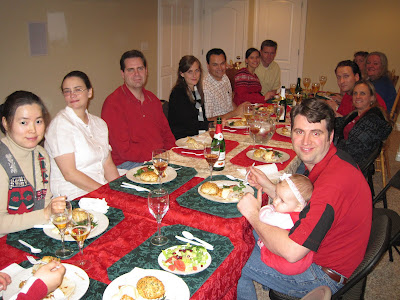 Ah, Sparkling Apple and Pomegranate juice.
 Lionhouses's Chicken Cordon Blue, Green Beans Elegant and Parmesan Roll
 White Elephant Gift Exchange: Some participants did not know what this is. There were some nice gifts; new Black Cauldron DVD, Wii Tennis Racket Accessories, CDs, Wood Shelf with Mirror,etc. Then some true W.E.; HUGE Santa stockings, candy jewelry (rings and bracelets), inflatable tub faucet safety device, a bag with a note saying "Warning: This bag contains some thing which is contagious!"--inside was a large bug bouncing on a spring, a jar containing NOTHING, funny picture frames, etc.


 Ladies playing Boggle
 Wii Tennis anyone?
 Amy (and her baby boy) are game.
We drank Wassail and ate Spinach Artichoke Dip with chips and french bread.
We mingled and gamed while Amy and Ryan finished the touches of a delicious dinner.
 Sad (sick) Steven and Eva like to play with Milo the dog.
 Sensational Salad
 Siblings Seated!
 Ah, Sparkling Apple and Pomegranate juice.
 Lionhouses's Chicken Cordon Blue, Green Beans Elegant and Parmesan Roll
 White Elephant Gift Exchange: Some participants did not know what this is. There were some nice gifts; new Black Cauldron DVD, Wii Tennis Racket Accessories, CDs, Wood Shelf with Mirror,etc. Then some true W.E.; HUGE Santa stockings, candy jewelry (rings and bracelets), inflatable tub faucet safety device, a bag with a note saying "Warning: This bag contains some thing which is contagious!"--inside was a large bug bouncing on a spring, a jar containing NOTHING, funny picture frames, etc.


Matt and Joe got the Nothing jars: Did you say nothing?
When you were asked what you wanted for Christmas.
Don't you remember saying NOTHING?
Well this time someone heard you, searched
high and low and found this perfect gift for you.
 Amy made a gingerbread trifle for dessert AND Chocolate Lava Cakes.
 Amy also had M &Ms she gave each couple a package of M&Ms that had a piece of paper which said, "Why did the blond get fired from the M&M factory? She kept throwing away all the 'W's."
She also gave out little packages of fun things to do with children at the holidays:
"This year you've been naughty and so you get reindeer poop" (chocolate covered raisins)
"This year you've been naughty and so all you get is snowman poop" (marshmallows)
Magic Reindeer Food. Pictures coming soon.
We also played with Wii Just Dance 2 and the Michael Jackson Dance. Yes, there was some video shot and lots of laughter and fun. No, it will not ever be posted here.
Friday, December 3, 2010
President's Party (Part 1)
 Rebekah met another Rebecca!
 Evie and I
 Jonathan and volunteer
 Hannah
 Susie's Purse

 Sweet Crafts!
Sugar Plum Fairy
 Hannah came over to the long Santa line and whuispered urgently, "I've got seats for everyone to watch the Nutcracker!" A local ballet company preforms the nutcracker and brought some of their dancers. Hannah informed me that instead of continuing with the local dancing class she would like to attend at this school across town and "dance more competitively."
President's Party (Part 2, Meeting Santa)
 The "arm" is Jonathan waving hello.
 Santa is shaking Susie's hand.
 Thank you kind lady behind us in line for snapping this, the best of the bunch!
 Eva was asleep in the stroller and was just waking up when
I handed her off to the man in the red suit. She couldn't figure him out.

 So...who is this guy, Mom?
 Jonathan needed to tell Santa that he changed his mind (and Santa letter)
last minute and wants a Kung Zhu Fighter (hamster toy) for Christmas.
Thursday, December 2, 2010
A Mini Miracle
Feeling overwhelmed today. I am trying to fix up my home fast for a sit down dinner with the Elder's Quorum and their children (47 ppl.) tonight at 6:00 p.m. Wishing my decorating was done and my house was perfectly clean and my children were the same. Catch the word *perfect* in there. I am happy people are coming to my home and hope that they will sense peace, joy, or anything but mess and a bit of madness here. It would be easier if I knew these people well and we were all *real.* Perhaps we will make some true friends over the next decade living here.
**Post-Edit...After writing this, I showered, prayed, and got moving even faster. Joe joined me at 4:00 and flew into action too. Joe's sister Anne saved the day shopping for us, baking the lasagnas in her HUGE oven, getting her son Mick to slice up veggies for the salad and bring over her large pots and salad bowl. Joe admitted we might have gotten in a little too deep on this one. Also, in hindsight, I would have happily paid Merry Maids (although money is scare) or some such service to come and dust and clean for me so I could focus on organizing and helping my toddler and baby. Live and Learn, Jules!
Mothering Multiple Children
This post is from a Blog called MamaBirth. Written by Sara C.
Humbling Moment #547: Women With More Than One Child Are Not Actually Crazy
Maybe you have been there. I remember having my one toddler. I was so patient. So kind. He was always breastfed to sleep. He was worn in a sling. He was loved all the time. He never cried for long periods. I was such a great mom. It was nice.
I remember seeing other women with two or more children. "Why are they so crazy?" I would ask myself. "Why are they so overwhelmed?" Or a really great one, "Why do they keep having kids when they don't seem to be handling the ones they have that well?"
Bwaaaahahahahahahahahahahhahahahahhahahah!!!!!!!
Sorry, I just needed to take a moment to laugh out loud at myself and my total arrogance and lack of understanding.
Fast forward. I now have three. There will be another one this summer. OH MY GOSH! Four kids.
I actually once saw a friend of mine take a tranquilizer because she was having such a hard time with her kids. I think I was just kind of in shock.
I get it now. I am not saying I take tranquilizers, just that I UNDERSTAND why you might want to on certain days. Just saying.
When you have more than one child you start to learn a few things:
~ You are not a perfect mom. Maybe with one you were. But not with three, and sure as heck not when you are full term and have a few others who can easily outrun you. Yelling starts to look REAL good.
~The first one (or second or third) was just easy. You were not actually doing everything right. It was actually just the child. (Oops on all the times you gave other women advice on how to get their baby to sleep through the night, huh?!) No, you don't have any special knowledge, you just got lucky.
~The other one, was just hard. You did not do anything terribly and horribly wrong. Neither did that friend you had with the "naughty" or "out of control" toddler. It was just a harder child or a difficult stage and you were just seeing them at a bad moment.
~Everybody has bad moments. You might have to have a few kids before you see yourself have a bad moment. But wait, it is coming. Sometimes you see a mom in one of her horrid moments. Don't judge her. It is just a MOMENT. She is not actually crazy and it will pass.
~Even though you appear nuts, you love your kids and want MORE. Yes, your hands are full. No you can not afford them. Yes, you sometimes mix up their names. This is not actually an indicator that you have trudged too far down the path of insanity. It is just LIFE. And life can be hard, but children are still awesome. You see the beautiful moments, where everybody gets along and where there is just a touch of the divine in your home.
~There is a reason women with more than one child say things like, "Yes, but I have 4 kids!" like it is an accomplishment. Or the other thing those mom's say, "You only have one."
They are not actually trying to insult you. They just know that with only one child there are a few things that you might not understand yet. And the whole. "I have X amount of kids comment," well, it is kind of an accomplishment. And it does explain some things in your life. Like the the messy purse/car/ or emotional state.
So, to all those mom's out there who I looked at with horror as you yelled or lost patience or cried in public. I apologize. I get it. I am getting mine. Thank you for actually making it look easier than it really is.
**Joe and I read the books, attended the expensive classes taught at the local hospital, and were "perfect" parents before we had children. Then we welcomed our first little one into our home and she had many, many lessons to teach us about how very imperfect we really are as parents. In some ways, every child that has come since has been easier--not that they haven't all had their own challenges but that we had learned and continue to learn about how to parent these little ones sent to our family.
I reread this post (on my sister-in-law's sisters' blog and sent to me again by her, thank you Melissa and Rachel).
Subscribe to:
Posts (Atom)
